
Meridian
Treasury intelligence for mid-market CFOs — turning cash visibility scattered across a dozen bank portals into decisions a finance team can make in minutes, not mornings.
OutcomeEstablished "honest data states" as a core pattern the team carried into build.

The Challenge
Mid-market finance teams run treasury out of spreadsheets stitched together from a dozen bank portals. Cash position is always a day stale, forecasting lives in someone's private workbook, and the answer to "can we cover payroll and the acquisition this month?" takes a morning of reconciliation to produce.
My client was building a treasury platform to replace that workflow and needed the core product designed from the ground up — from discovery research through build-ready screens. I led product design end to end, embedded with the founding team and their finance advisors.
- Discovery Research
- Information Architecture
- Task Flows
- Product Design
- Design System
Research
Contextual inquiry and interviews with twelve mid-market CFOs, treasury analysts, and controllers over five weeks — watching them run the morning cash ritual, build forecasts, and approve payments in the tools they actually use.
What I Designed
A consolidated cash position that reads as a single answer, with data freshness stated on the record — a "live vs. stale" pattern that became a core principle. A 13-week forecast built for the board conversation, not the spreadsheet. Covenant monitoring with early-warning thresholds so a breach is a heads-up, not a surprise. And multi-party approval chains that mirror how finance teams actually sign off.
The whole surface is honest about what it doesn't know. When a feed is stale, it says so — because in treasury, a confident wrong number is worse than an honest gap.
Screens
The six screens that carry the product — from the CFO's portfolio view to the controller's covenant monitor. Every number states its freshness, every workflow has a primary action, and payment approval is enforced across three people, never one.
The CFO's default landing screen. Answers the primary question — "What is my cash position right now and is anything wrong?" — within seconds of login. Designed to support a 5-minute morning review without requiring any navigation.
Single-entity view accessed from the Portfolio Overview. Shows account-level breakdown, intraday movement, and pending transactions. Shown here: Cascade NE Subsidiary — the entity with an active anomaly alert.
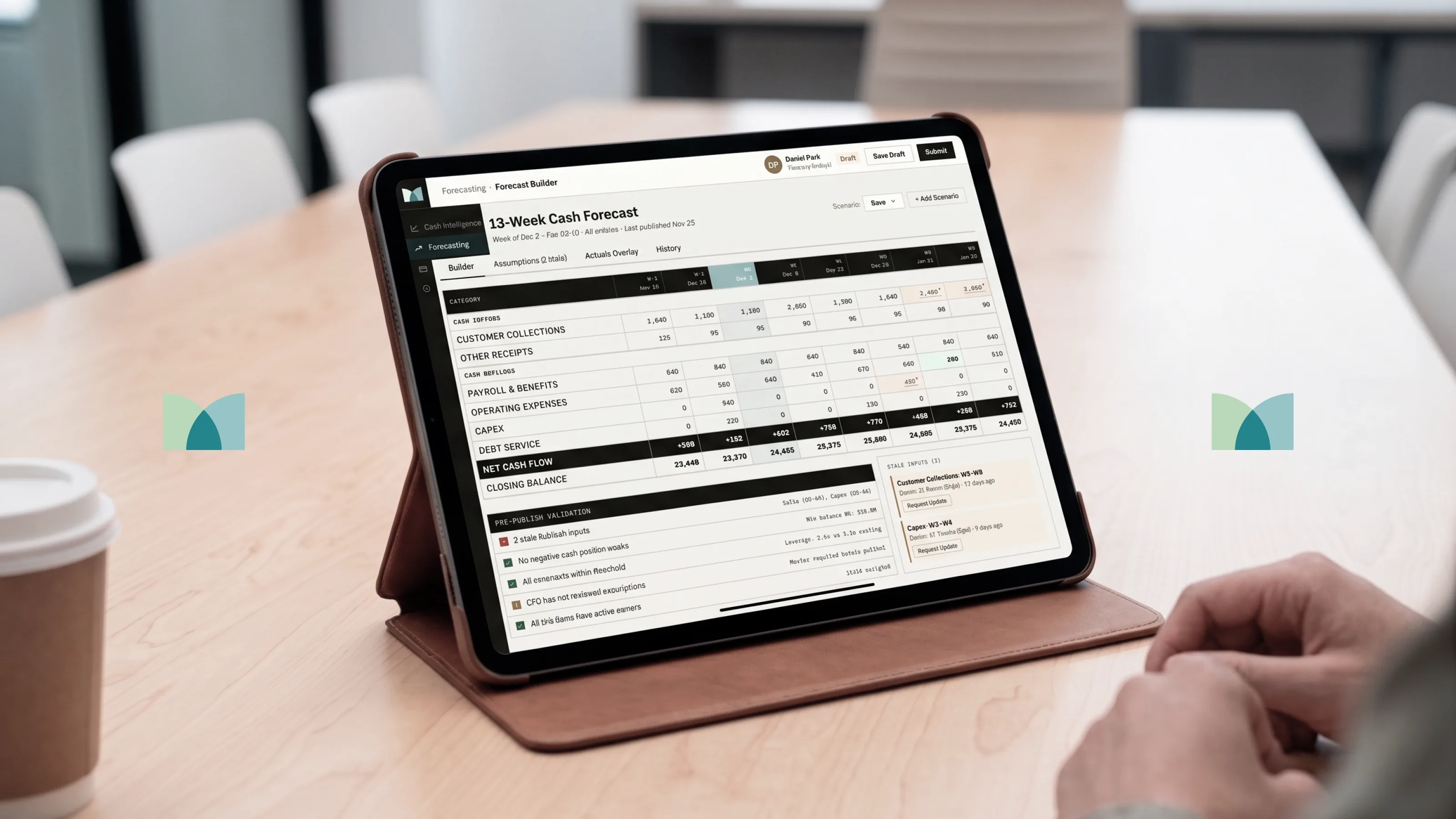
Daniel's primary operational workspace. The 13-week rolling forecast with live data overlay, assumption ownership, staleness indicators, and the waterfall cash position chart that updates as he edits. Highest-density screen in the product.
Daniel's payment creation form. Structured, validated, and enforces the beneficiary whitelist and OFAC check before submission. Shows the pre-submission validation summary and approval routing preview — so Daniel knows exactly what will happen before he submits.
Maya's approval view on a phone. The highest-stakes interaction in the system, designed for use between meetings, in a taxi, or at an airport. Full payment detail visible without scrolling. One-tap approve with biometric confirm.
Sandra's primary compliance workspace and the CFO's covenant health view. Real-time covenant status, trend direction, days to next certificate, and the alert that triggered Flow F4. Designed to reduce Sandra's daily covenant anxiety by making the status always visible and always current.
Outcome
- Delivered a build-ready product design — research, IA, task flows, and a full screen system — and handed it to engineering to implement.
- Collapsed the daily cash review from a dozen bank portals into a single surface the whole finance team reads the same way.
- Established "honest data states" as a core pattern the team carried into build.
- Gave a small founding team a reusable design language to ship against.