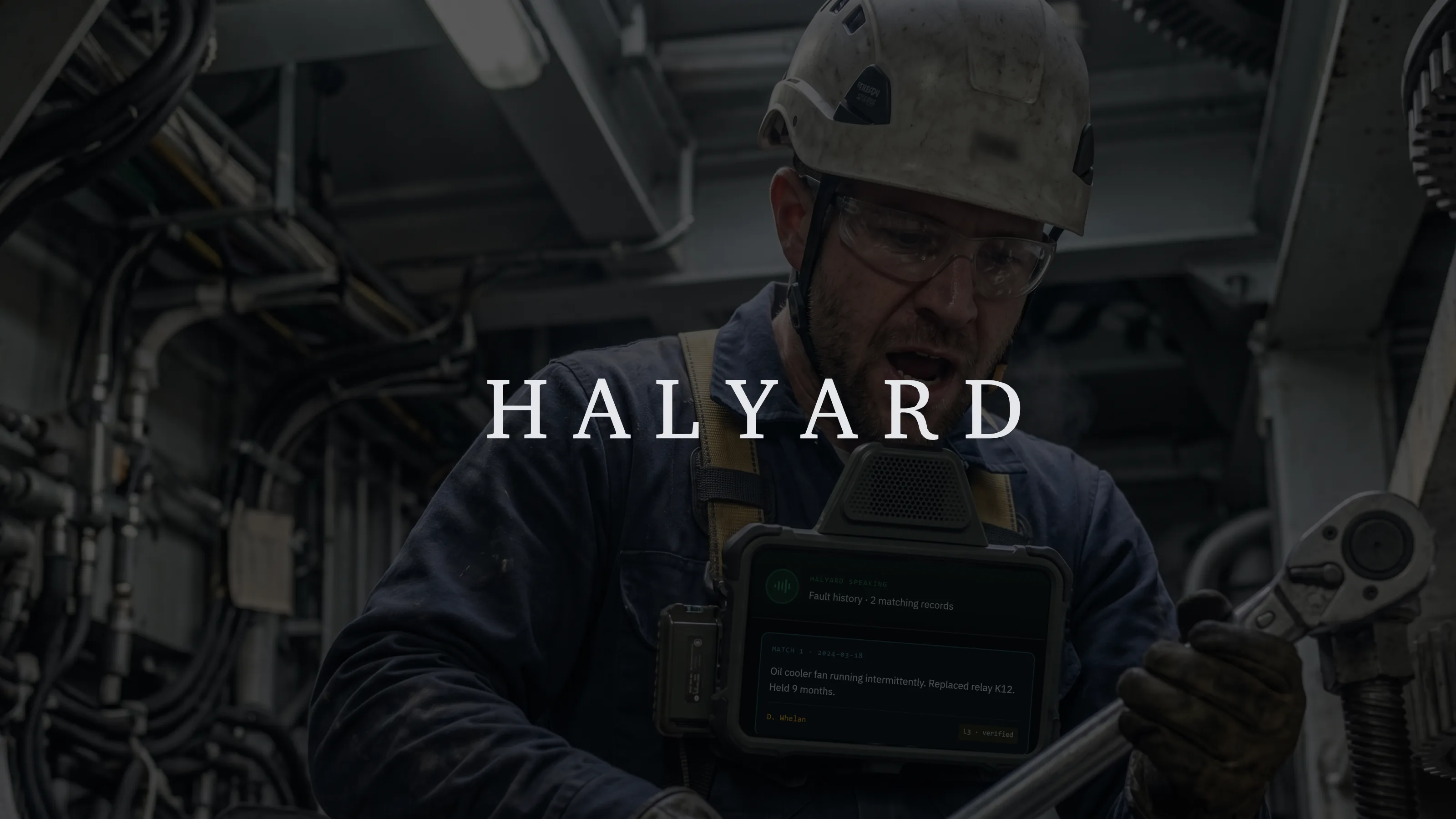
Ewan is competent and physically confident on the tower — what slows him down is the non-routine: an unfamiliar fault, a variant-specific spec he doesn't have memorized. He's not hostile to technology, but his scepticism toward the tablet his employer issued him is earned: slow to wake, battery fails in the cold, half its functions need signal he doesn't have.
Halyard
A voice-first field agent for onshore wind technicians — guided procedure execution and diagnostic reasoning with no hands, no eyes, and no connectivity required.
OutcomeSpecified a fixed-phrase confirmation pattern for safety-critical steps that makes an ambiguous "yeah" structurally unable to advance a lockout sequence.

The Challenge
A wind turbine technician spends the working day ninety metres up, inside a nacelle the size of a shipping container, wearing a fall-arrest harness, hearing protection, and gloves rated for electrical work. The machinery is loud. Their hands are on a torque wrench. And yet everything they need — the torque spec for this turbine variant, the isolation checklist, the fault history that would tell them another technician found the same problem four months ago — is on a tablet they cannot safely reach.
The result is a workflow built on interruption: stop, de-glove, retrieve the device, find the information, re-glove, resume. Fourteen times per turbine visit, on average, costing roughly two and a half minutes each — and often skipped entirely, with the technician working from memory instead. My client was building a voice-first agent to remove that interruption. I led research, conversation design, and product design from the acoustic field study through build-ready specification.
- Contextual Inquiry
- Acoustic Field Study
- Conversation Design
- Dialog State Modeling
- Multimodal Wireframes
The Approach
I spent nine weeks across four sites in Scotland, Germany, and Texas — GWO-certified, harnessed, following the same protocols as the crew — running ride-alongs, nacelle contextual inquiry, and Wizard-of-Oz voice trials where I acted as the agent over radio while technicians worked. A parallel acoustic field study measured ambient noise at nine work positions across three turbine models, because the entire product direction depended on whether speech recognition could function in that environment.
The Wizard-of-Oz trials surfaced the design risk that shaped everything downstream: technicians respond to a read-aloud safety instruction with "yeah," "mm-hm," or a grunt — while still mid-step. A system that accepts that as confirmation will eventually advance a lockout procedure past an incomplete isolation. Every safety pattern in this project traces back to that one finding.
Research
Fourteen participants — technicians, site leads, and O&M managers — across ride-along observation, nacelle contextual inquiry, calibrated acoustic measurement, and eighteen Wizard-of-Oz voice sessions.
The de-gloving tax produces avoidance, not just delay
Six of nine technicians observed admitted to working from memory rather than looking up a specification, specifically because the lookup was too disruptive to be worth it. Two of those instances involved torque values.
"Getting the gloves off, finding the tablet, waiting for it to wake up, finding the right page — for a number I probably already know? I'll just do it."— P09 · Technician, 5 yrs, West Texas
The nacelle is a dead zone in every sense
Cellular connectivity inside the nacelle was unusable in 100% of measured sessions, at every site, on every fleet. Technicians had already built workarounds — screenshotting pages before climbing — which are themselves a source of error when the work order updates after the screenshot was taken.
"Everyone screenshots. And when you need the one you didn't screenshot, you either climb down or you guess."— P05 · Technician, 2 yrs, Schleswig-Holstein
Safety steps are where voice gets dangerous
When the researcher-as-agent read a safety isolation sequence aloud, technicians frequently responded with ambiguous acknowledgements while still performing the step. In a human radio exchange that's unremarkable. For an automated agent, it's a hazard — accepting "yeah" as confirmation of an electrical isolation step will eventually advance a procedure past an incomplete safety control.
"You say yeah because you're listening, not because you're done. If the thing takes that as done and moves on, that's how someone opens a panel that's still live."— P01 · Lead Technician, 11 yrs, Scottish Borders
Technicians want a colleague, not a system
Technicians responded well to a register resembling a competent colleague on a radio — direct, willing to say "I don't know." They responded poorly to anything resembling a consumer voice assistant. Explicit uncertainty raised trust; confidence theatre was actively disliked.
"Don't make it chirpy. I need it to tell me the number and shut up. If it doesn't know, say it doesn't know — I'd rather that than it making something up."— P07 · Lead Technician, 13 yrs, West Texas
Personas
Three roles across the operational hierarchy. Ewan is the primary user — Halyard is designed for him first. Marisol governs the knowledge layer it creates. Thomas holds the safety accountability that determines whether it can be adopted in the field.
Twelve years in the nacelle before moving into leadership gives Marisol credibility a purely managerial appointment wouldn't have. She'd own Halyard's knowledge governance — when a technician flags that a spec is wrong, she decides whether it propagates fleet-wide, and she's acutely aware of the risk of institutionalizing an error.
Thomas is the buyer, and the person most likely to kill the project — not from resistance to technology, but because he won't approve anything that could plausibly contribute to an incident. He's been in the industry long enough to have known people who were injured. Any pitch that leads with efficiency and treats safety as secondary fails with him immediately.
Scope & Trade-offs
The brief could have grown into a general-purpose maintenance platform. I scoped it down to the interaction that actually removes the de-gloving tax, and deferred everything adjacent.
Turbine control was cut entirely — Halyard is advisory only, and any action affecting machine state runs through certified controls the technician operates directly. That boundary isn't a UX nicety; it's what makes the product approvable at all for a buyer like Thomas, whose primary objection is exactly this risk.
Predictive analytics, blade inspection and drone imagery, and offshore operations were deferred as different workflows for different users. Scheduling and dispatch stay with the existing CMMS — Halyard receives the work order, it doesn't create or optimize it. And autonomous report submission was never on the table: the technician always reviews and signs, and no report leaves the device unsigned.
- Cut: Turbine Control
- Deferred: Predictive Analytics
- Deferred: Offshore Operations
- Kept: Guided Procedure + Diagnostic Reasoning
What I Designed
Three functions, in priority order — documentation is deliberately third, a byproduct of the first two rather than a task the technician performs. Guided procedure execution reads torque specs, sequences, and safety steps aloud at the technician's pace, confirming critical steps explicitly and never advancing on a timer. Diagnostic reasoning lets the technician describe symptoms and hear likely causes ranked by probability, informed by fleet history — including what a specific previous technician found on this specific machine, with attribution spoken aloud.
Underneath both sits a register model that shifts from conversational to terse the moment the interaction crosses a safety boundary — sentences shorten, structure becomes numbered, and the confirmation requirement changes from any casual acknowledgement to one fixed phrase. The shift is itself a signal to the technician that the stakes have changed, backed by a two-tone earcon at the boundary and a 0.95 confidence floor with no margin for interpretation.
Information Architecture
A voice-primary product has no navigation the technician can browse or recover a wrong turn from — the architecture lives entirely in what the system can understand and what it holds in context. Thirty-one intents organize into six families, each with its own confidence floor and failure behaviour calibrated to the cost of being wrong, not to a single global accuracy target.
Establish or confirm situational context. Safe to guess narrowly and ask for clarification.
Fetch a spec, history, or reference value. Never fabricates — states uncertainty explicitly instead.
Drives guided execution. On low confidence, repeats the step rather than advancing.
Isolation, lockout, verification, emergency stop. Halts and re-confirms on any ambiguity; escalates on repeat failure.
Records observations and values, always read back for confirmation before committing.
Lowest stakes, cheap to retry — session and playback control only.
Task Flows
Four states from the dialog model, traced through a single turbine visit — from the moment Ewan wakes Halyard at the tower base to the safety gate that justifies the whole product.
Session start & context binding
Halyard binds to the work order, verifies the offline cache is current, and reads context aloud before Ewan climbs — the last moment he's likely to look at a screen for hours.
Specification retrieval mid-procedure
A three-word question — "what's the torque?" — contains no component, variant, or spec type. The context stack supplies all three; Halyard answers and returns to the exact step, position never lost.
Isolation sequence — fixed-phrase confirmation
Register shifts to terse. "Yeah, that's done" is rejected on semantics, not confidence — only "CONFIRM" advances the sequence. Three consecutive failures halt the procedure and log an anomaly.
Recognition failure & modality shift
Recognition degrades as the turbine idles for a running check. Halyard escalates through three repair tiers — never repeating a strategy, never apologizing — and defers to the screen the moment voice genuinely can't carry it.
Outcome
- Delivered a build-ready conversation and product design system — dialog states, confidence thresholds, repair strategies, and six multimodal screens — handed to speech and platform engineering.
- Specified the fixed-phrase confirmation pattern as an architectural safety control, not a UX preference — the design artifact Thomas needed to approve the pilot.
- Designed the three-layer organizational learning model (lexicon, protocol, field knowledge) with governance built in at the point of contribution, not bolted on after.
- Set the product's own bar: fewer than 3 device interruptions per visit (from a baseline of 14), and over 96% of safety steps explicitly confirmed — the two numbers that matter most to field adoption.
